Product updates, industry perspective, and stories from the team building Radar.
Introducing the Location Intelligence Graph, with ML-based risk scores and fraud hotspot detection
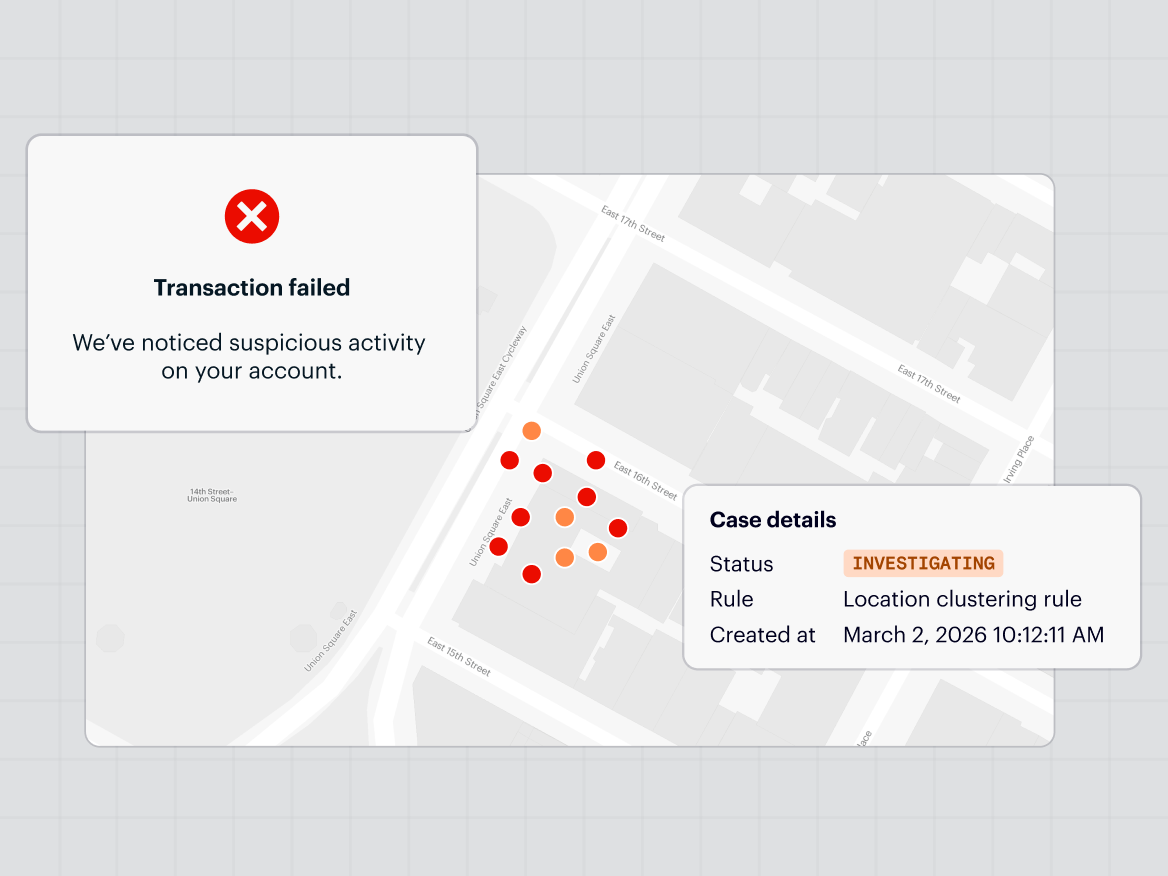
Introducing Radar’s Location Intelligence Graph, combining 100 billion precise location observations per year with machine learning to power more accurate location intelligence and smarter fraud detection
Nick Patrick
Co-Founder and CEO
Product
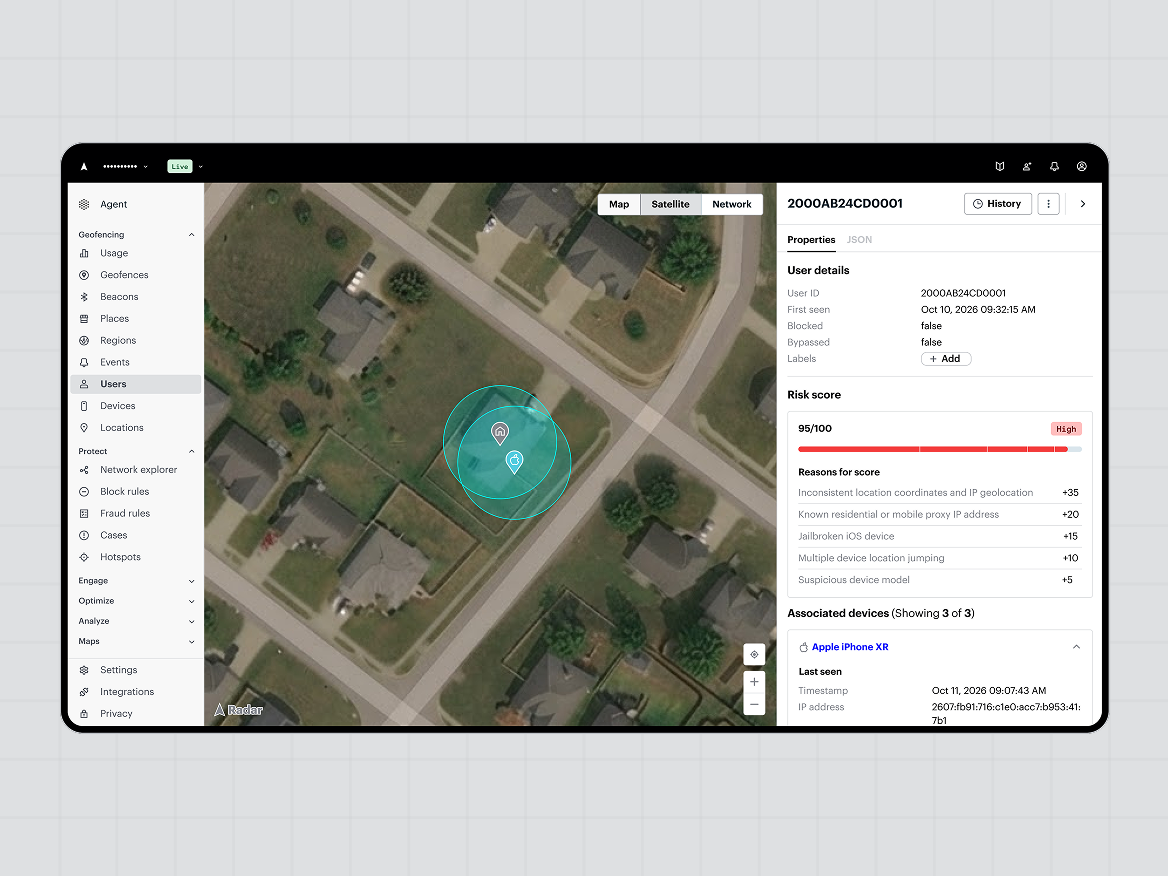
RF-1: an ML-based user and device risk model, built on the Location Intelligence Graph
David Gurevich
Software Engineer
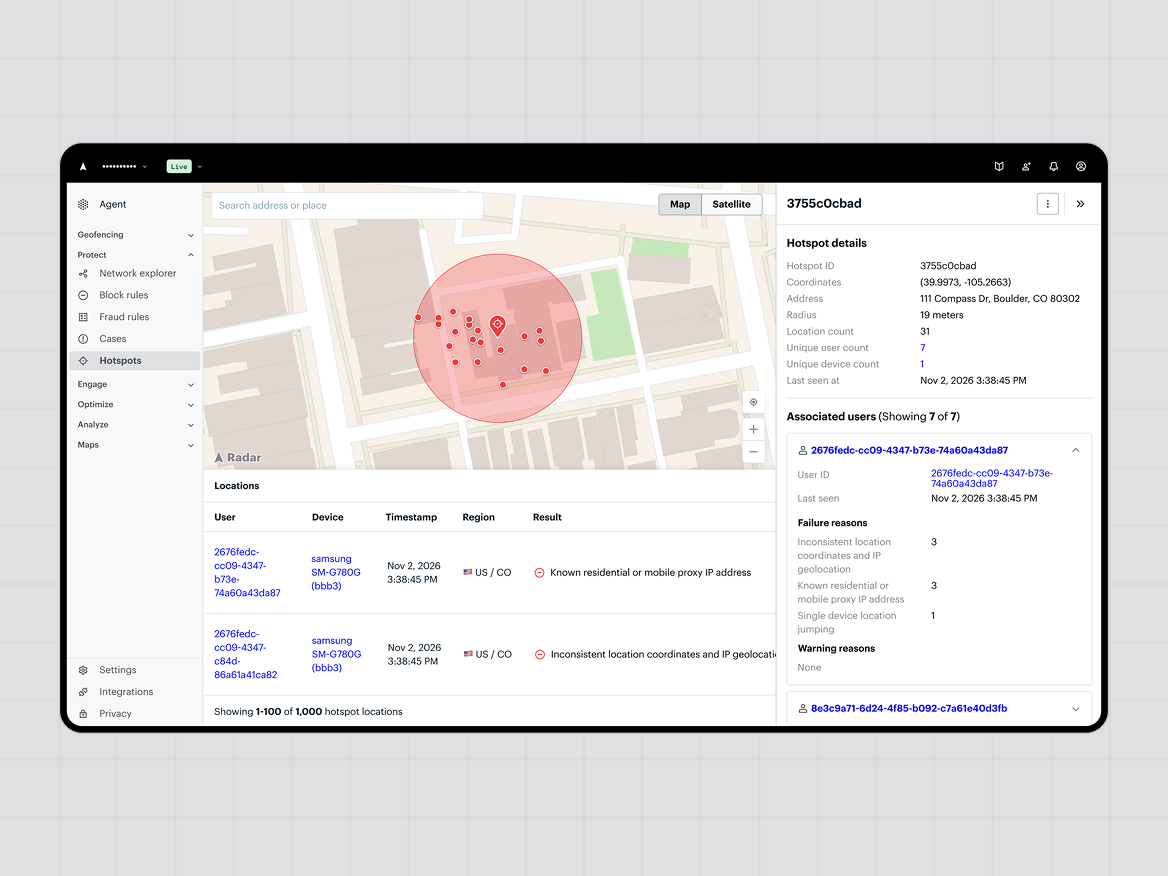
Detect coordinated fraud others miss with precise location and fraud hotspots
Kyler Day
Fraud Operations Lead
Guides
Mapbox vs. Google Maps API: 2026 comparison (and better options)
Radar Team
Resources
What is a mule account, and how does precise location detect it?
How to investigate suspicious activity with the Radar MCP server in Claude or ChatGPT
Nick Donnelly
Senior Product Engineer
Industry
Watch on demand: How to use AI and location to make faster risk decisions
Rachel Rosensweig
Product Marketing Lead, Fraud
Introducing Radar’s MCP server and integrations with ChatGPT and Claude
On demand: How precise location uncovers fraud signals traditional signals miss
Three ways to use precise location to detect and prevent fraud
Location signals in fraud prevention: Why precise location reveals the connections IP misses
How does location intelligence detect coordinated fraud in financial services?
Company
From location infrastructure to location intelligence: Radar’s latest brand refresh
Audrey Na
VP of Design
Campaign scheduling and user insights
Radar Reveal, network explorer, and residential proxy detection
How to prevent location fraud in mobile apps
Nicholas Anasa
Fraud Operations Manager
Alberta is open for business: What the iGaming Alberta Act means for operators
How to choose a mapping SDK in 2026
Location spoofing explained: what it is and how to stop it
6 location infrastructure platforms for apps in 2026
12 best Google Maps API alternatives on the market right now
Inside the rideshare fraud economy: 5 patterns costing platforms millions
The 5 most common types of marketplace fraud, and how to prevent them
The 5 payments fraud patterns hiding outside the transaction, and how to prevent them
The 5 most common types of courier fraud in food delivery, and how to prevent them
12 best Mapbox alternatives in 2026
How Foot Locker uses location to power its omnichannel experience
The true cost of the Google Maps API and how Radar compares in 2026
Radar 2025 recap and 2026 preview
Radar Maps Platform showcase: Store locators, checkout forms, and more
The real cost of doing nothing with location
The complete guide to geocoding APIs (and why Google isn’t always the best fit)
Food delivery fraud: how real-time location and delivery tracking reduce losses
Real-time delivery tracking for food delivery apps: From map pins to fraud prevention
What is a points-of-interest (POI) API? Building context-aware, location-based apps
How accurate is geofencing? The truth about real-world precision
Engineering
Building HorizonDB in production
Binh Robles
Product Engineer
What is geofencing? Geofencing definition, history, applications, and more
What is reverse geocoding? Use cases and examples across industries
How logistics and freight platforms use maps APIs to power real-time visibility and efficiency
What is a geocoding API? How product teams use it to power location features
The critical role of maps APIs in modern product experiences
Why address validation APIs matter for product and engineering teams
What is an isochrone map? A complete guide with examples and tutorials
Location permissions guide: 3 keys to boost opt-ins and deliver user value
Why location is everything: How geolocation powers modern digital experiences
Maps API for QSRs: Powering smarter, faster order-ahead experiences
Maps API for retail: Boost conversion, reduce costs, and improve customer experience
Automate clock-in and clock-out with geofences
What is geofencing? How product teams use geofencing APIs to build smarter location features
Build vs. buy: Why retailers choose a partner for geolocation infrastructure
Not all geolocation vendors are created equal. Here’s why.
Why leading retailers are investing in Store Mode
Why geofencing is mission-critical for QSRs
Why geofencing is a must-have for modern retail
How we replaced Elasticsearch and MongoDB with Rust and RocksDB
Jeff Kao
Staff Engineer at Radar
Spring 2025 product release
On the Radar with Turvo
Limitations of the USPS API for address validation
Maps API use cases, features, and real-world examples
Winter 2025 product release
On the Radar with Five Below
3 predictions for the geolocation compliance market in 2025
Address verification software: The 10 best options on the market right now
Radar 2024 recap and 2025 preview
Forward geocoding vs. reverse geocoding
15 best reverse geocoding tools on the market today
Radar Maps Platform updates: International address coverage and Maps Studio
Radar IRL 2024: Magical experiences start with location
Geolocation compliance updates: LexisNexis alliance, Geo-Compliance Premium, licensing, and more
Leveraging an address autocomplete API for faster form filling and nearby search
Geofencing iOS: Understanding the limitations
Radar is now processing 1 billion API calls per day
Route optimization API: Plan efficient routes for vehicles, workers, and fleets
Route matching API: Snap coordinates to maps and road networks
Introducing HorizonDB
Tim Julien
CTO
The best geocoding API: Choosing between Radar, Google Maps, and others
Geo-compliance updates: Product, press, licensing, conferences, and more
Reverse geocoding: Convert latitude and longitude coordinates into addresses
Radar 2023 year in review and 2024 preview
Radar brand refresh: Designing for the future of location-based experiences
Radar IRL 2023: Maps, geo-compliance, and the future of geofencing
Introducing our fraud detection and geo-compliance solution
Introducing Radar Maps Platform
Announcing our partnership with Cordial
Google Geocoding API pricing: Cost management and alternatives
The top 5 geofencing use cases for convenience store and fuel apps
What is geocoding? Geocoding explained: Definitions, applications, solutions, and more
Announcing our new address validation API
Announcing our partnership with Bloomreach
Add location features to your no-code app with a new integration from Glide
Radar 2022 year in review and 2023 preview
Radar IRL and the next generation of location tech
How Radar uses TypeScript to manage Terraform via CDKTF
How businesses use beacons to power location-based experiences
Announcing remote configuration for the Radar SDK
Radar raises $55 million Series C led by Insight Partners
Ringing in the new year with a new domain name: radar.com
Why QR codes are cool again (and what to expect next)
The new Radar mission and the next generation of location-based experiences
Recipe: Reactivating users during and after COVID-19 with Regions
Radar raises $20 million Series B led by Accel to build developer-friendly, privacy-first location data infrastructure
Radar raises $8 million Series A to scale modern, privacy-first location context platform
Our commitment to privacy
Welcoming Tim Julien, our new CTO
Millions of devices, new partnerships, and a $2 million seed round led by Accel
Making sense of new background location restrictions in iOS 11 and Android O
An Android location services tutorial for iOS developers
Introducing Radar